
Arrest Warrants in Taylor County
An arrest warrant is a judge's order telling an officer to bring a named person before the court. Georgia law spells out who may sign one. Under O.C.G.A. § 17-4-40, a superior, city, state, or magistrate judge may issue it, and so may a municipal officer holding magistrate powers, for an offense against Georgia penal law. The finding must rest on probable cause drawn from the officer's own knowledge or sworn information. That standard asks whether enough facts exist for a reasonable judicial finding that the offense occurred and that this person committed it. In Taylor County, Magistrate Court publicly lists arrest warrants, search warrants, and warrant applications among its duties. Superior Court holds felony jurisdiction, and its Clerk keeps the Superior criminal records. City courts may also issue warrants inside their own narrower jurisdiction.
Taylor County Arrest Warrant Applications
Early warrant matters in Taylor County usually land in Magistrate Court, whose published work covers warrant applications, criminal arrest warrants, search warrants, certain misdemeanors, county ordinances, and preliminary criminal matters. The office sits at 2 N Broad Street in Butler and answers at 478-862-3357. Not every Taylor County arrest warrant stays in a Magistrate file, though. A felony case can move on to Superior Court, and a city offense may begin in municipal court. The official Magistrate Court duties set out that division of labor.
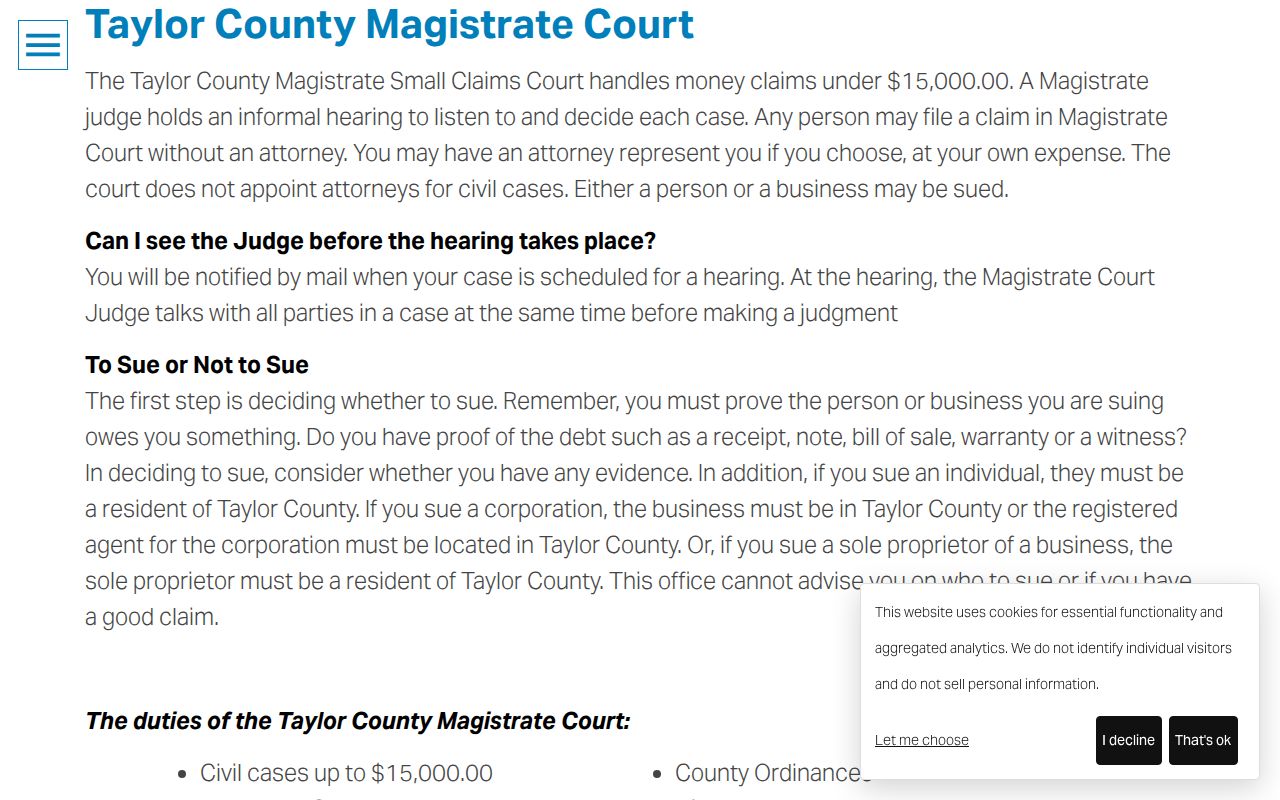
That official page names the local application channel in Taylor County. It publishes no warrant records and no public name-search roster.
Key point: A warrant application is a request for judicial review; it is not proof that a Taylor County arrest warrant was issued.
What a Taylor County Arrest Warrant Contains
Georgia's statutory warrant form identifies a core set of facts. Taylor County publishes no sample warrant listing. These fields therefore describe the legal form and useful request terms. Ask the court or sheriff which fields can be released and which are sealed, redacted, or part of a pending investigation.
| Georgia and county | The jurisdiction in which the warrant issues. |
|---|---|
| Person | The individual whom the warrant commands an officer to arrest. |
| Sworn affiant | The person supplying sworn information for probable cause. |
| Offense | The conduct or penal offense described in the warrant. |
| Issue details | Date, county, and judicial authorization shown by the form. |
| Command | Direction to arrest and bring the person before a judicial officer. |
| Possible local fields | Case number, status, bond, and serving agency, if public and recorded. |
The Taylor County warrant-number format is not published. Treat any example number as invented, not as evidence of how local records are coded.
Taylor County Arrest Warrant Path
The path starts with a sworn complaint, affidavit, or application. An authorized judicial officer then weighs probable cause. If the standard is met, the Taylor County arrest warrant issues and can be entered in court and law-enforcement systems. Georgia's criminal-information systems are not a public statewide warrant search. Routing stays local, even when an officer elsewhere can see and act on an entry.
- An officer or complainant gives sworn facts to an authorized judicial officer.
- The judicial officer tests those facts for probable cause under Georgia law.
- An issued warrant is routed to the relevant court and law-enforcement systems.
- The sheriff, a city police officer, or another authorized officer may execute it.
- The person is brought before a judicial officer for the next case and bond steps.
- Records are updated after service, recall, quash, or other court action.
"Executed" or "served" means the warrant was carried out. It does not show that the charge was dismissed or that the Taylor County criminal case has ended.
How Taylor County Arrest Warrants Are Served
O.C.G.A. § 17-4-46 directs the warrant form to a sheriff, deputy sheriff, coroner, constable, or marshal. In Taylor County, the Sheriff's Office is the main service, jail, and custody channel. The county lists the office or jail at 478-862-5444 and non-emergency dispatch at 478-862-5451. Butler and Reynolds police act within city matters and may coordinate service, but neither city publishes a public warrant portal. The Taylor County Sheriff's Office page gives contact and jail links rather than a searchable warrant database.

No name-search form appears there. That does not mean no Taylor County arrest warrant exists. Call and ask whether staff confirm status by phone and what identifying details they need.
Taylor County Arrest Warrant Roles
Taylor County's court levels answer different record questions. Magistrate Court handles warrant applications and preliminary matters. The Superior Court of the Chattahoochee Judicial Circuit holds general and exclusive felony jurisdiction, and the Taylor County Clerk of Superior Court maintains its criminal case records. Butler and Reynolds municipal courts take city traffic and ordinance cases. Reynolds's charter expressly gives its municipal judge warrant authority for city ordinances and state offenses within the city.
| Office | Arrest-Warrant Role | Contact |
|---|---|---|
| Taylor Magistrate Court | Applications, issuance, and preliminary criminal matters | 478-862-3357 |
| Superior Court and Clerk | Felony case and filed order records | 478-862-5594 |
| Taylor Sheriff and jail | Service, custody, and local status inquiry | 478-862-5444 |
| Butler Municipal Court or police | Butler city process | 478-862-5435 or 478-862-9333 |
| Reynolds Municipal Court or police | Reynolds city process under charter authority | 478-847-3435 |
The county court-system page shows how these county offices divide their work.

The court chart points to a two-part check. Ask Taylor County law enforcement about service, then ask the issuing court about the case and its judicial status.
Arrest Warrant vs Summons vs Bench Warrant
Similar papers can demand different responses. A summons directs a person to appear without commanding arrest. A bench warrant usually grows from a missed court duty in an existing case. A Taylor County arrest warrant rests on a probable-cause finding tied to an alleged penal offense. Read the document title and issuing court before making the next call.
| Process | What Starts It | Immediate Meaning |
|---|---|---|
| Arrest warrant | Sworn probable cause | Authorizes custody and presentation to a judicial officer |
| Summons | Court or charging process | Directs appearance by a stated time |
| Bench warrant | Missed setting, contempt, or noncompliance | Compels return to the court that set the duty |
| Search warrant | Probable cause concerning evidence | Authorizes a search of the described place, person, or items |
Taylor County sources do not confirm "capias pro fine" as a local label. Ask the clerk to read the exact term recorded in the case.
Taylor Arrest Warrant Records Requests
Taylor County posts no public arrest warrant list, and the sheriff runs no name search online. So pick up the phone. Call the sheriff first, then Magistrate Court for an application or preliminary matter, or the Superior Court Clerk for a felony case already filed. The clerk's case-search route exists, but its provider and account limits mean it is not a list of unserved warrants. Only a direct answer from the court settles the question. When an office will not simply tell you, put the request in writing under the Georgia Open Records Act. Name the record you want, the dates, the court, the case number if you have it, and ask for electronic delivery. The law gives agencies three business days to produce responsive records or give a timeline. Search and copy fees may be lawful. Some material can be withheld, though. Pending investigative files, confidential sources, sealed records, and juvenile records may be redacted or refused outright. If Taylor County withholds something, ask the custodian to cite the exact exemption. One withheld field does not mean the whole case is closed to you.
What to Do If There's a Warrant for You
Taylor County offers no warrant safe harbor, no surrender window, no local bond schedule, and no warrant-specific bond form. State guidance is blunt on one point: asking in person can end in immediate arrest. If you believe a Taylor County arrest warrant exists, call from a safe place. Do not treat a quiet online search as proof. Get legal advice before you walk into any office in person.
- Confirm the name, date of birth, issuing court, alleged offense, and current warrant status with the sheriff and court.
- Ask whether the court or jail can state bond status, judge-setting needs, and acceptable appearance arrangements.
- Speak with a Georgia criminal-defense lawyer about voluntary surrender, a planned first appearance, bond, or a recall request where lawful.
- Follow the exact place and time given by the authorized office. Taylor's published address sources conflict, so verify the destination.
- After service or court action, confirm the warrant record with both the issuing court and the law-enforcement custodian.
Act carefully: Do not visit a warrant office based only on an old address; call first because a Taylor County arrest warrant may lead to custody.
When the court allows it, bond secures a future appearance. It does not erase the charge. The Taylor County warrant records overview lays out the main resolution routes across warrant types.
Taylor County Arrest Warrant Bonds
The county court page says the Magistrate Judge may grant bail unless another court holds that power. That is general authority, not a published Taylor County arrest-warrant amount. Cash bond, surety bond, personal recognizance, property security, and no-bond holds are all possible. Which one applies, and at what figure, depends on the warrant, the offense, and the judge. So ask before you assume anything. The jail or the issuing court can give the amount, the bond type, any judge requirement, the accepted payment method, and the posting location. Confirm the address too. The county and the Georgia Sheriffs' Association list different sheriff or jail street locations, so verify where bond is actually handled in Taylor County. The county publishes no bond-window hours and no public form. And Reynolds's citation payment methods, including its $150 contempt fee, say nothing about the terms of an arrest-warrant bond.
Verify Taylor Arrest Warrant Status
After an arrest, surrender, bond, recall, or quash, confirm the result with two offices. Ask the court what the judge ordered and whether the underlying case is still set. Ask the sheriff or police custodian whether its service record now shows the update. Know the vocabulary. A recalled warrant was withdrawn by the issuing court; a quashed one was set aside by judicial order. "Cleared" is looser, and it may not dispose of the charge itself. Georgia runs no public statewide warrant portal. A clean Taylor County check therefore cannot rule out process from another county or a federal court, and public access may lag or omit sealed and investigative records. Write down the date, the office, and the person who advised you. Keep every receipt and order, and ask when each connected system should reflect the new status.
Note: A citation payment or missing online result is not proof that a Taylor County arrest warrant has been withdrawn.